
Why the nineties mattered
There's a third character in JFK Jnr and Carolyn Bessette Kennedy's love story- and that's the last great artistic decade on earth

This week’s essay is free for all to read. If you like it I’d love it if you could give it a little ‘like’ or share at the end so that others can read it too. And if you want more essays like this every week, as well as my recommendations then why not become a paid subscriber by hitting the button above. Thanks for reading.
When I think back to the 1980s, I remember only sensory things: the smell of mowed grass on the playing fields next to school; broiled skin after a day in the sun; the smell of Giorgio Beverly Hills on my mum’s neck. What I don’t remember is how I felt and what I thought. Not really. The eighties then feel like an old photo album, filled with snapshots of a life I somehow inhabited but yet barely knew.
But the nineties? The nineties were different.
I was 12 years old in 1990 and 22 when the world ushered in a brand new millennium. I fell in love, made my own money, left home and had my heart shattered all in the space of a single decade. The nineties then, were my decade.
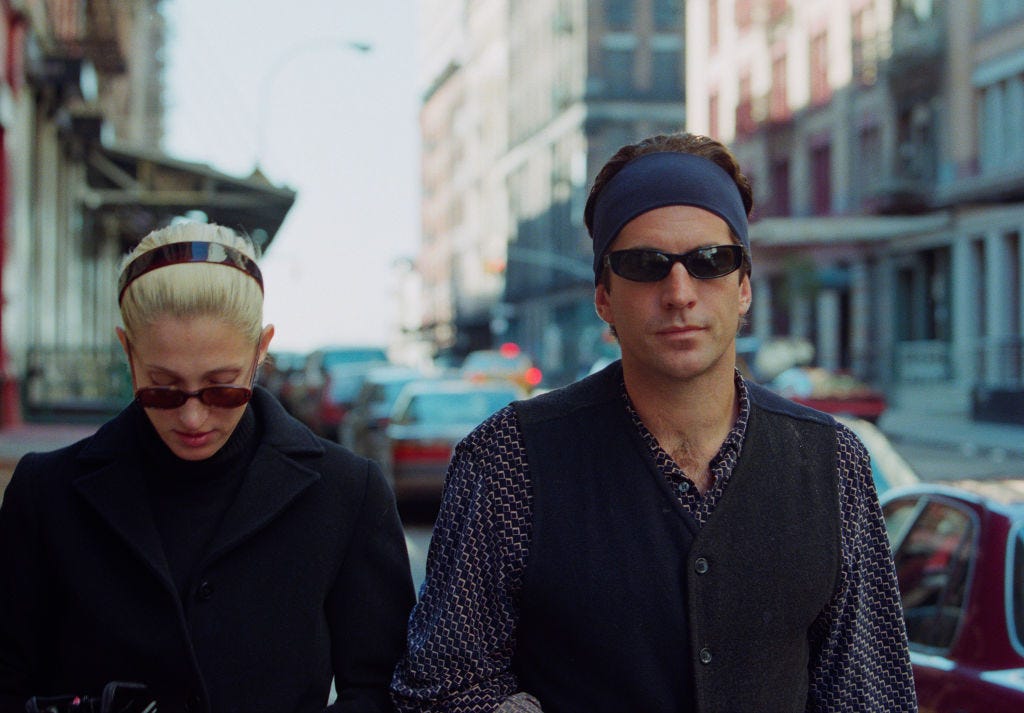
I mention this now because this past week I’ve been obsessed (and I mean obsessed) with Disney’s new show, Love Story. Love Story is ostensibly about the tempestuous relationship between Carolyn Bessette Kennedy and JFK Jnr. But really, it’s a love letter to the 1990s.
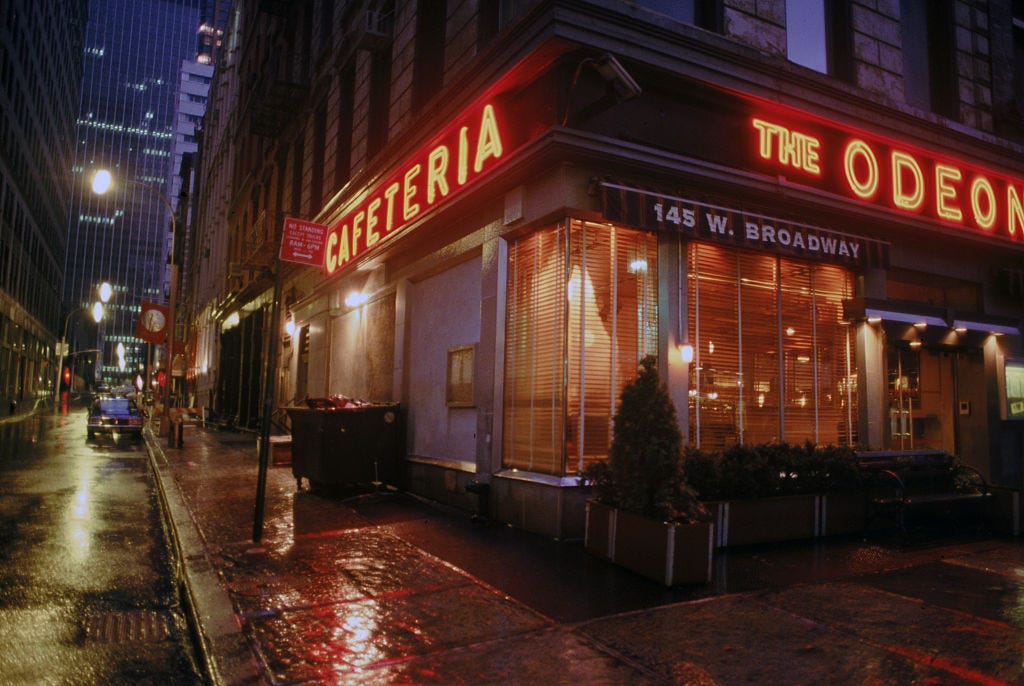
Every song, every outfit, every NYC restaurant and every cloud of Marlborough Red smoke is a painful reminder of just how brilliant the 1990s were. Watching each episode then is like taking a journey back to a past self that feels both painfully distant and yet reassuringly close.
The decade in which you spent your adolescence is arguably the one that shaped you most. And if you believe, as I believe, that the self is like a stretched elastic band, with a beginning and an end that somehow find themselves back to one another then it’s all the stuff in between, the stuff we choose to define ourselves by that makes the difference.
When you’re growing up that definition comes from the culture around you: the music, the art, the books, the clubs, all of which we use as a language to communicate who we are (or indeed who we hope to be) as we set about finding our way. But it’s also more than that, culture becomes you. The bands you grew up with, the magazines you loved, the TV shows you adored, seep into the very fabric of your life, defining your tastes, but also your values and even the direction in which your life eventually takes. Culture then provides us not only with a voice when we have none; but also a path down which to travel.
I feel lucky then that I grew up in the nineties, a time when most bands wrote their own music; a time when authors could make it without a social media following, a time where attention was allowed to ebb and flow and delayed gratification (waiting for the next episode of Jeanne Becker’s Fashion TV in my case) meant you valued culture like it was a precious stone.
This was a pre Internet age, a time when culture prioritised internal reflection over external perception. I remember spending hours in my bedroom trying to figure out what the words to Alanis Morissette’s Jagged Little Pill meant, often looking inwards for the answers. I don’t know who today’s Alanis Morissette is, but I bet she’s on Instagram taking selfies.
In the 1990s if you liked a song you had to listen to the radio for hours on end hoping, praying it would come back on. (Oh how I longed for a full version of Vanilla Ice’s Ice Ice Baby.) And when it did, you’d scramble to tape it on your little cassette tape, always missing the first 10 seconds. In the 1990s every boy I knew was also in a band. They noodled away in garages across Manchester and Liverpool and small towns no one had ever heard of. In the 1990s nobody wanted to be an influencer. They wanted to be an artist- a musician, a writer, a photographer. And they knew that graft and application was the thing to get them there. They didn’t hope for a viral post that would present them with overnight (but usually momentary) fame or for ChatGPT to write them a piece of music or an entire essay. Instead you did the thing thing, aimed for quality, trusted the process and hoped it would work out . Overnight success was neither expected not applauded. In fact in the insouciantly anti-establishment 1990s, slaving away in the dark carried its own status. The term ‘indie’ was an actual thing- a byword for artistic discernment. I was proud to be an indie kid- after all popularity carried neither status nor credibility. In fact if something was hard to track down- Manchester city centre’s HMV music store never had any of the Lemonheads’s rare B sides I so desperately craved- that was sort of the point. Great art didn’t come to you; you had to seek it out. You had to be dedicated. And in that dedication the art somehow became you.
In the 1990s there were abundant art grants and cultural prizes too- bundles of them that favoured the contemporary and experimental. In 1995 Damian Hurst took home The Turner Prize, whilst a then largely unknown female writer and bookshop keeper called Ann Patchett was shortlisted for the 1998 Orange Prize for fiction. Today there are fewer artistic grants and prizes than ever before. And so, if you’re a creative kid growing up in some forgotten corner of the land then you have only social media to fall back on, where algorithms dictate taste and form.
However, one of the things that truly struck whilst watching Love Story was the tale of Calvin Klein. Calvin Klein could not exist today (although much of The Row looks suspiciously like Calvin Klein circa 1993). Klein was bold and boundary-eviscerating, making a prepubescent-looking Kate Moss the star of his campaigns for much the 1990s. (Do not tell me the image of Moss naked on a dirty sofa is not meant to shock.) His fragrance CK One meanwhile, on which I based my Lancashire Rotary Club public speaking application-much to the horror of the elderly judging panel, would be seen as ideologically problematic today. Whilst the exacting way in which he ran his empire from the Calvin Klein HQ at 205 West 39th Street - only white flowers, no eating at desks and black turtlenecks and deep side partings for the girls, would be all over Glassdoor.
Now forgive me if this all sounds like a sad old woman lamenting about how things used to be better in the good old days. That is not my point. After all, there are so many things that are better today- the internet democratising knowledge for a start. But maybe, if we want to create good culture; if we want to make art that sings to the soul or write words that lodge in the memory then we could start by looking back at one of the last century’s most underrated decades.
Now it’s over to you…I would love to wander down memory lane with you and see what you remember best about the 1990s. And if you weren’t there? I’d love to know what culture has made a difference to your life.
Loved this, Farrah - and I sort of feel you've described Substack: "you did the thing thing, aimed for quality, trusted the process and hoped it would work out..."
The 90s sort of passed me by, illness and deep unhappiness but I completely agree that the decade of your adolescence leaves an indelible impression, the eighties being mine. The tribes; Wham/Duran/The Cure and you had to nail your colours to the mast. MTV, Live Aid, AIDS, Thatcher, Falklands War, I can recall it all like it was yesterday. Not always happy but always memorable, when life was an undiscovered country.